Trelzuno
Vertex Framework
Vertex Framework
Couldn't load pickup availability
1. Problem Statement
At this stage, a learner can already create tables, describe fields, and understand basic relationships, but difficulty appears when building a larger schema. If the structure grows without clear rules, duplicates, conflicting values, extra dependencies, and confusion between table roles may appear. A learner may see that a database works in a separate example, but may not always understand whether it will handle new records, new categories, or new learning scenarios in an orderly way. There is also a need to describe keys, constraints, and relationship rules more precisely so data remains organized. That is why this plan explains how to build a solid database frame before moving into more complex queries.
2. Solution
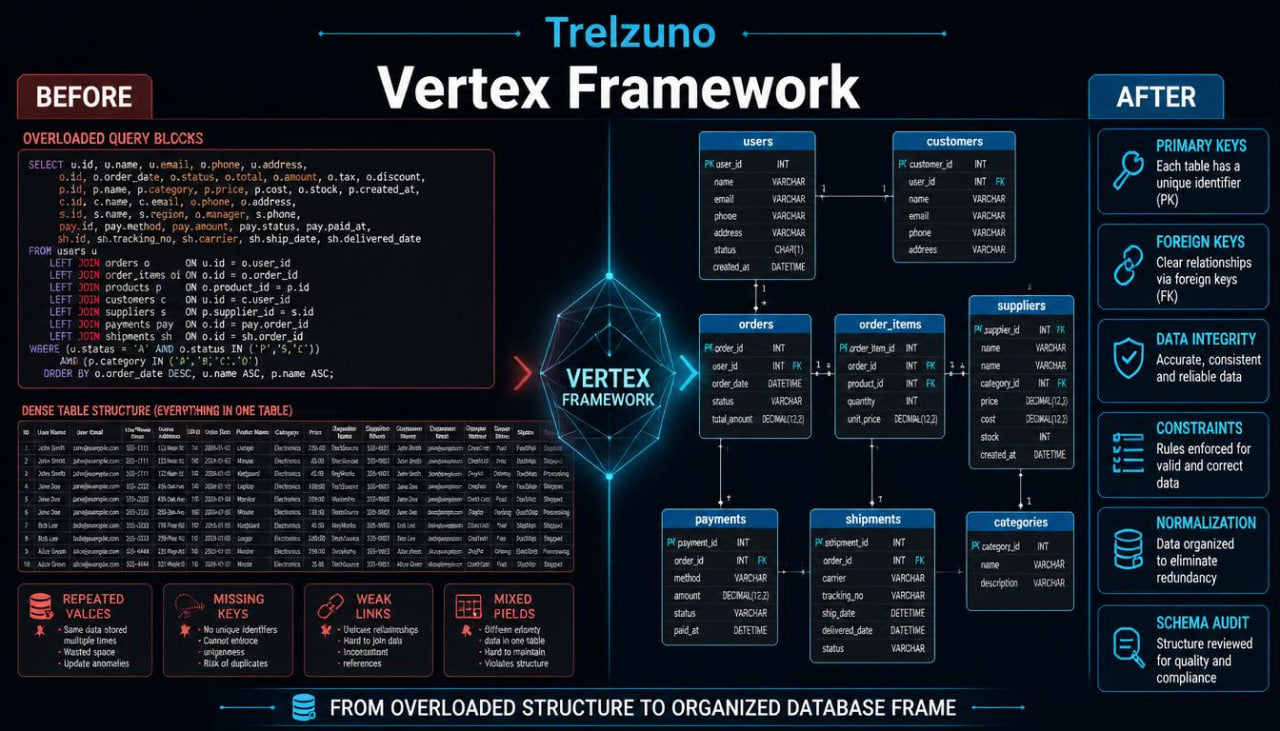
Vertex Framework helps learners see a database as a structural frame where each table, key, and rule has its own purpose. The plan explains how to reduce extra duplication, separate dependencies, build relationships through keys, and describe rules for values in tables. The materials show how one schema can be refined gradually: from an early version to a cleaner model with reference tables, junction relationships, and control constraints. Learners work with examples where they need to review structure for repetition, logic issues, and weak points in data organization. This approach prepares learners for plans where the main focus moves toward complex selections, deeper relationships, and project-based database work.
3. What’s Inside
Vertex Framework begins with a block about the database frame. Learners study how a schema can stand on several main supports: tables, keys, relationships, data types, constraints, and naming rules. The material explains that a strong structure does not appear by accident; it is built through careful analysis of data, its roles, and dependencies between records.
The second block focuses on primary keys. Learners review the role of a unique identifier and look more deeply at why each main table should have a field that clearly separates one record from another. Examples show why a learner name, course title, or creation date does not always fit identification. The materials explain how an identifier helps build relationships, update records, and avoid mixing similar values.
The third block reviews foreign keys. Learners study how one table can refer to a record in another table and why these references form the basis of relationships. For example, a section table may contain a course identifier, a material table may contain a section identifier, and a learner registration table may contain both learner and course identifiers. Through these examples, learners see how a database keeps connections between structure parts without duplicating descriptive data.
The fourth block focuses on data integrity. It explains why values in tables should follow rules: required fields should not be empty, number fields should contain numbers, dates should follow one format, and references to other tables should point to existing records. Learners review error examples where a course refers to a category that is not present, or a record has a status that is missing from a reference table.
The fifth block explains constraints. The materials show how constraints help describe rules for values: a field cannot be empty, a value should be unique, a date should follow a needed format, and a status should belong to a defined set. Learners see that constraints are not extra weight, but a way to make a structure more attentive to mistakes in learning examples.
The sixth block focuses on normalization. Learners meet the idea of separating data so each fact is stored in the right place. The materials explain why a category title should not be repeated in every course, why learner details should not be duplicated in every course registration, and why statuses are often better placed in a reference table. Everything is shown through “before” and “after” examples, where one large table gradually becomes a cleaner schema.
The seventh block reviews dependencies between fields. Learners study how to understand what a certain field value depends on. For example, a course title depends on a course record, a section title depends on a section record, and a status change date depends on an event in a log. The material helps learners avoid situations where a field appears in the wrong table or repeats information from another schema part.
The eighth block focuses on junction structures. Learners review tables that describe relationships between records in greater depth: learners and courses, courses and tags, materials and topics, sections and review tasks. The materials explain which fields are needed in such a table, when to add a date, status, or note, and when two references to connected records are enough.
The ninth block explains preparation for multi-table queries. Learners do not yet move into a detailed study of every construction, but they learn to build a schema so future queries can be read more clearly. For example, if a query will need to show a course title, section title, and number of materials, the structure should contain proper relationships between courses, sections, and materials. The material shows how planning affects later data reading.
The tenth block contains a learning schema audit. Learners receive a ready schema with mistakes: duplicated titles, unclear fields, missing keys, mixed table roles, repeated statuses, and incorrect relationships. The task is to find weak points, explain the issue, and suggest a cleaner structure. This format develops attention to detail and the ability to see a schema as one complete construction.
The eleventh block is practical work with the Trelzuno frame. Learners create a structure for a learning catalog with courses, sections, materials, learners, registrations, statuses, categories, and a change log. They need to define primary keys, foreign keys, reference tables, junction tables, required fields, and rules for separate values. Then the schema is reviewed through a checklist.
The twelfth block contains the plan summary frame. It brings the topics into one sequence: keys, relationships, integrity, constraints, normalization, dependencies, junction tables, preparation for multi-table queries, and schema audit. Learners see how a database moves from a set of tables into a thoughtful learning frame.
4. Who Is This For?
Vertex Framework is suitable for learners who already have a basic understanding of tables, schemas, relationships, queries, and data flows. It is useful for those who want to plan structure more carefully, with attention to keys, rules, dependencies, and future queries.
This plan also suits learners who want to understand why one schema is easy to read while another creates confusion. If a learner can already create a basic model but wants to analyze its quality more deeply, Vertex Framework provides the right learning space for this stage.
5. What You’ll Learn
- How to see a database as a structural frame.
- How to define primary keys for main tables.
- How foreign keys work between connected tables.
- How to describe data integrity rules.
- How to notice empty, extra, or conflicting values.
- How to use constraints in learning schemas.
- How to separate data through normalization.
- How to reduce extra duplication in tables.
- How to define dependencies between fields.
- How to understand which table should store a certain value.
- How to create reference tables for statuses and categories.
- How to build junction tables for deeper relationships.
- How to prepare structure for queries across several tables.
- How to conduct a learning schema audit.
- How to create a database frame for the Trelzuno catalog.
6. 30-Day Return Terms
For Vertex Framework, there is a 30-day period for submitting a payment return request according to the Trelzuno store policy. Details about timing, review conditions, and request steps are described in the store policy so learners can read the procedure before placing an order.
Self-paced learning overview
- 🗂️ Digital file available after purchase
- 🕒 Long-term availability
- 🔐 Secure checkout
- 🗓️ Content updated in 2026
Are Trelzuno courses suitable for beginners?
Are Trelzuno courses suitable for beginners?
Yes, the materials are arranged so learners can move from basic ideas to more advanced topics gradually. Each plan has its own depth, so learners can choose a format that matches their current level.
How are the learning materials presented?
How are the learning materials presented?
The materials are presented through modules, explanations, examples, tasks, diagrams, and practical learning blocks. Everything is arranged so learners can work through the topics at a steady pace.
How do the plans differ from each other?
How do the plans differ from each other?
Each next plan includes a wider set of topics, more practical examples, and deeper explanations of database work. The first plans are suitable for orientation, while later ones explore structure, logic, queries, and project-based thinking in more detail.
Share