Trelzuno
Loom Capsule
Loom Capsule
Couldn't load pickup availability
1. Problem Statement
At the ninth stage, learners already understand tables, keys, relationships, references, log records, and multi-table queries, but a new challenge appears when all of these parts need to become one system. Separate queries may work correctly, while the overall model may still be difficult to explain. A learner may know how to count records or build a route between tables, but may not always see how these actions fit into a larger learning schema. Difficulties also appear when the task is not only to check the result of one query, but to review the consistency of the whole structure. That is why this stage focuses on weaving tables, rules, selections, and scenarios into one logic.
2. Solution
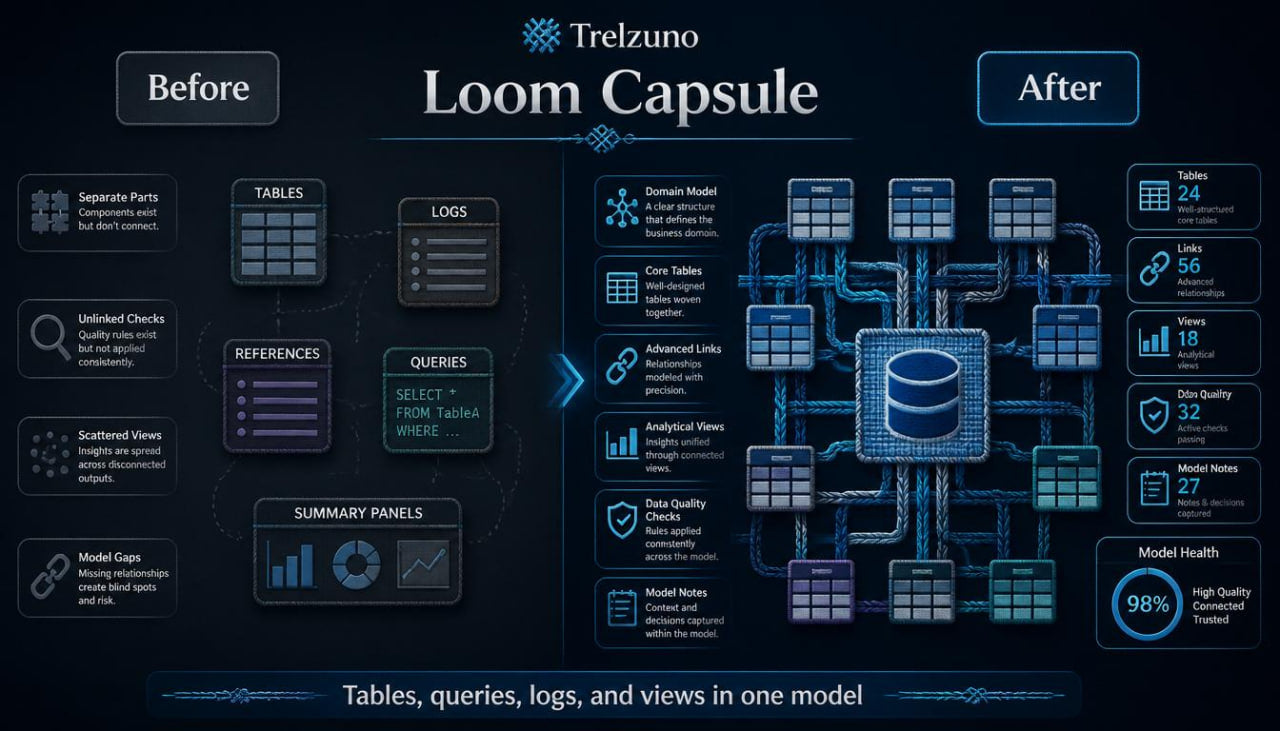
Loom Capsule presents a database as a woven learning model, where each table has a place, each relationship has an explanation, and each query has its own role in the wider picture. The plan helps learners connect structure with practical scenarios: from object description to analytical selections, from change logs to data review, from references to summary tables. The materials show how to create a learning schema that can answer several different questions without adding fields chaotically. Learners work with examples where they need not only to write a query, but also explain why this structure gives the needed result. This approach prepares learners for the final plan, where the whole database is reviewed as a learning project.
3. What’s Inside
Loom Capsule begins with a block about whole-structure thinking in databases. Learners review a schema not as a set of separate tables, but as a weaving of objects, events, references, relationships, and selections. The material explains how one table can influence several tasks, and how one relationship may matter for different query types. For example, a learner registration table can be used to review statuses, count course participation, analyze changes, and build summary learning views.
The second block focuses on the domain model. Learners study how to describe the learning area before creating structure: which objects exist, which actions happen with them, which states they may have, which events should be stored, and which questions the database should support. Using the Trelzuno example, the plan reviews courses, sections, materials, learners, registrations, statuses, categories, tags, events, and summary selections.
The third block explains the role of main tables in a larger model. Learners define which tables form the core of the schema and which ones have a supporting role. For example, courses, learners, and materials may be central objects, while categories, statuses, and material types clarify values. The material helps avoid overloading main tables with extra fields and mixing descriptive values with events.
The fourth block focuses on deeper relationships. Learners revisit junction tables, now within the context of a broader model. Relationships between courses and tags, materials and topics, learners and courses, events and objects are reviewed. The materials explain how to describe such relationships so they remain readable during schema review and while creating selections.
The fifth block centers on analytical selections. Learners study how a database can answer not only “what is stored,” but also “how many,” “in which groups,” “by which statuses,” “in what order,” and “with which related data.” For example, learners can count materials in sections, registrations by status, events by type, or course distribution by category. The material explains how these selections depend on the quality of the starting schema.
The sixth block reviews summary tables and learning views. Learners meet the idea of a prepared result that gathers data from several tables for review. For example, a learning view may show a course, its category, number of sections, number of materials, number of registrations, and latest event. The materials explain how such views help read a database from different angles.
The seventh block focuses on data quality. Learners study how to check duplication, empty values, incorrect relationships, inconsistent statuses, records without matching references, and events without connected objects. The plan includes checklists that help review a schema before creating more detailed selections. A separate part explains why data quality affects the correctness of summary results.
The eighth block explains control queries. Learners create queries not for main analysis, but for structure review. For example, they may find records without a status, materials without a section, categories without courses, events without a connected object, or duplicate titles within one group. The material shows that these checks are an important part of working with a larger database.
The ninth block reviews model documentation. Learners describe not only tables, but the logic of the entire structure: main objects, supporting references, event layers, table routes, common selections, and control checks. This description helps the model be read again later and explained without unnecessary guessing.
The tenth block contains the Trelzuno practical model. Learners work with a learning database where they need to describe the full structure: courses, sections, materials, learners, registrations, statuses, categories, tags, events, references, and summary selections. Tasks include building the schema, describing relationships, creating control queries, preparing analytical views, and checking data.
The eleventh block focuses on error analysis in a full model. Learners receive examples where the structure seems to work but contains hidden issues: queries count extra rows, statuses repeat, log records are not connected to main tables, references partly duplicate one another, and some relationships do not have a defined role. The materials show how to find the reason for the issue through sequenced analysis.
The twelfth block contains the plan summary map. It brings together the topics: domain model, main tables, supporting tables, relationships, analytical selections, summary views, data quality, control queries, documentation, and error analysis. Learners see how a database can become not just a set of learning examples, but a thoughtful structure with different reading levels.
4. Who Is This For?
Loom Capsule is suitable for learners who already understand multi-table queries, database layers, log records, aggregation, and result review. It is useful for those who want to connect all these topics into one learning model.
This plan also suits learners who want to see not only a separate query, but the whole structure logic: from tables and keys to analytical selections and control checks. Loom Capsule fits well before the final plan, where learners work with a full database learning project.
5. What You’ll Learn
- How to think of a database as one learning model.
- How to describe a data area before creating a schema.
- How to define main and supporting tables.
- How to connect references, logs, relationships, and selections.
- How to work with deeper relationships between objects.
- How to create analytical selections from several tables.
- How to count records by categories, statuses, and types.
- How to prepare summary learning views.
- How to review data quality in a schema.
- How to find records without needed relationships.
- How to create control queries for structure review.
- How to notice duplication and inconsistent values.
- How to document a full database model.
- How to analyze errors in a large learning schema.
- How to prepare structure for the final project-based plan.
6. 30-Day Return Terms
For Loom Capsule, there is a 30-day period for submitting a payment return request according to the Trelzuno store policy. Details about timing, review conditions, and request steps are described in the store policy so learners can read the procedure before placing an order.
Self-paced learning overview
- 🗂️ Digital file available after purchase
- 🕒 Long-term availability
- 🔐 Secure checkout
- 🗓️ Content updated in 2026
Are Trelzuno courses suitable for beginners?
Are Trelzuno courses suitable for beginners?
Yes, the materials are arranged so learners can move from basic ideas to more advanced topics gradually. Each plan has its own depth, so learners can choose a format that matches their current level.
How are the learning materials presented?
How are the learning materials presented?
The materials are presented through modules, explanations, examples, tasks, diagrams, and practical learning blocks. Everything is arranged so learners can work through the topics at a steady pace.
How do the plans differ from each other?
How do the plans differ from each other?
Each next plan includes a wider set of topics, more practical examples, and deeper explanations of database work. The first plans are suitable for orientation, while later ones explore structure, logic, queries, and project-based thinking in more detail.
Share