Trelzuno
Free Kit
Free Kit
Couldn't load pickup availability
1. Problem Statement
Many learners begin studying databases through scattered explanations, which can make the topic feel confusing from the first stage. The difficulty often comes not from the subject itself, but from the lack of a clear sequence between concepts, examples, and practice. A learner may know separate terms but still not understand how tables, fields, records, and relationships work together. Without a basic structure, it becomes harder to move toward queries, sorting, filtering, and data model design. That is why the starting plan should provide a calm introduction to the topic without overload.
2. Solution
Free Kit is built as an introductory route that explains basic database ideas through clear examples and short learning blocks. The materials help learners see not only separate definitions but also the logic behind organizing information. The plan covers tables, records, fields, data types, simple relationships, and basic usage scenarios. Each topic is presented in sequence so that new material builds on what came before it. This format suits a first look at Trelzuno and helps learners choose a deeper plan later.
3. What’s Inside
Free Kit includes a set of introductory materials that introduce learners to the basic language of databases. The first block explains what a database is in a learning context, why data needs order, and how structure helps people work with information. Learners meet simple examples: a client list, a course catalog, an order table, a learning journal, a material list, or a contact base.
The second block focuses on tables. It explains why a table is a central element in many databases, how it is built from rows and columns, how a record differs from a field, and why column names should be clear. Learners see table examples with short explanations of each part.
The third block introduces data types. It covers text values, numbers, dates, logical markers, and identifiers. The material explains why choosing a suitable type for each field matters and how it affects ordering, filtering, and later work with records.
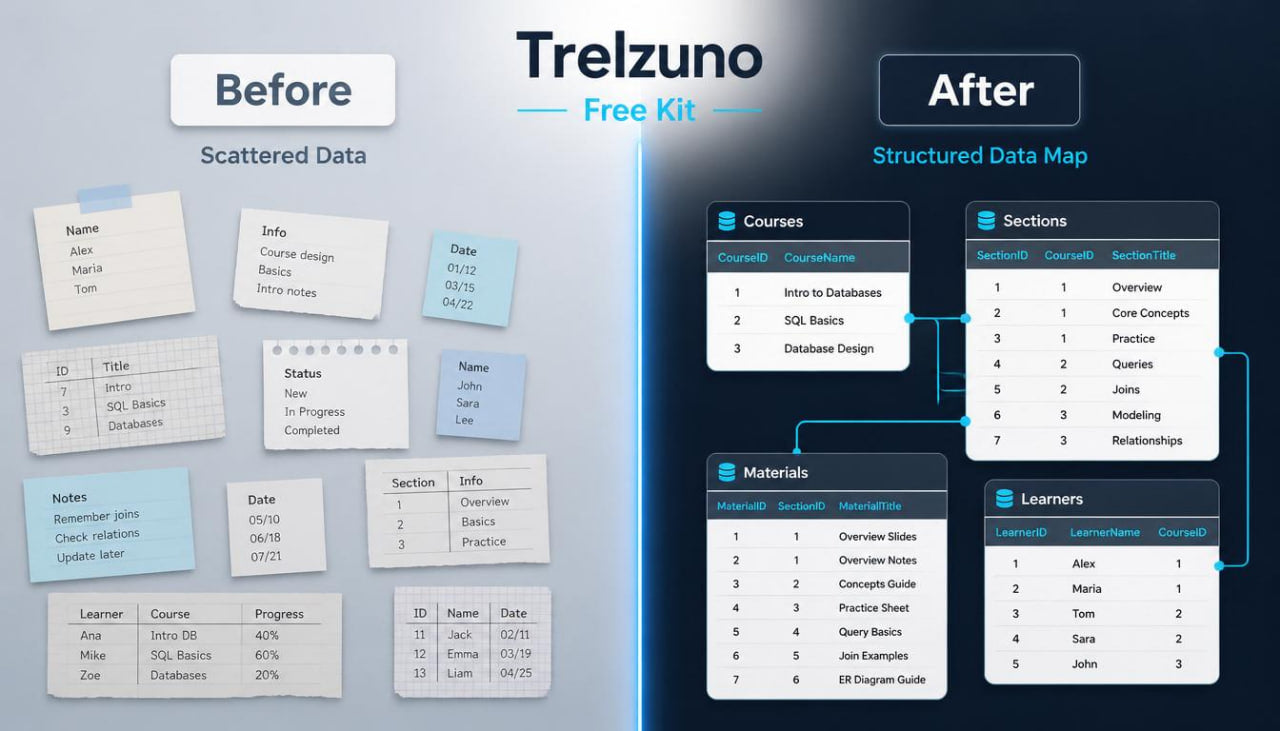
The fourth block explains basic relationships between tables. Learners meet the idea that data is often not stored in one large list but divided between several connected tables. A simple example shows how a student table can connect with a course table, or how an order list can connect with a catalog of items.
The fifth block introduces queries. It explains that a query is a way to receive the needed part of data based on a condition. Learners see examples of selecting all records, searching by value, sorting a list, and filtering records by date or category.
The sixth block focuses on tidy structure. It covers simple rules: avoid unnecessary duplication, use clear names, keep values in a consistent format, and think through the structure before filling tables. This block helps learners see that a database is not just a group of tables, but an organized system.
The seventh block includes small practical tasks. Learners can describe the structure of a simple base for a learning catalog, create a list of fields for a table, define data types, find unnecessary duplicates in an example, and suggest a basic relationship between two tables.
The plan also includes a short glossary. It explains terms such as table, field, record, key, relationship, data type, filter, sorting, query, and model. The glossary helps learners return to definitions while working through the materials.
Free Kit also contains a mini learning map. It shows how learners can move from basic ideas to more detailed topics: table structure, relationship logic, queries, normalization, analytical selections, and schema planning. The map does not overload learners with details; it simply shows the general direction.
4. Who Is This For?
Free Kit is for learners who are just starting to explore databases and want to understand the main ideas without heavy terminology. It is also useful for learners who have already heard about tables, queries, or relationships but want to arrange that knowledge into a more ordered picture.
This plan can work as a first step before choosing a broader Trelzuno learning package. It avoids overloading the learner with complex topics and provides a base for further study. It also suits those who want to review the teaching style, module structure, and overall logic of the learning materials.
5. What You’ll Learn
- What a database is and why data structure matters.
- How tables, rows, columns, and records connect.
- How a field differs from a record.
- Which data types are often used in tables.
- Why field names should be clear and consistent.
- How basic relationships help divide information between tables.
- What a query is and how it helps receive needed records.
- How simple sorting and filtering work.
- How to notice duplicated data in learning examples.
- How to create a basic scheme for a simple learning base.
- How to read simple table examples and explain their structure.
- How to prepare for deeper study of models, queries, and relationships.
6. 30-Day Return Note
For Free Kit, there is a 30-day period for submitting a payment return request according to the store policy. Review conditions, timing, and request steps are described in the Trelzuno policy so learners can read the procedure in advance.
Self-paced learning overview
- 🗂️ Digital file available after purchase
- 🕒 Long-term availability
- 🔐 Secure checkout
- 🗓️ Content updated in 2026
Are Trelzuno courses suitable for beginners?
Are Trelzuno courses suitable for beginners?
Yes, the materials are arranged so learners can move from basic ideas to more advanced topics gradually. Each plan has its own depth, so learners can choose a format that matches their current level.
How are the learning materials presented?
How are the learning materials presented?
The materials are presented through modules, explanations, examples, tasks, diagrams, and practical learning blocks. Everything is arranged so learners can work through the topics at a steady pace.
How do the plans differ from each other?
How do the plans differ from each other?
Each next plan includes a wider set of topics, more practical examples, and deeper explanations of database work. The first plans are suitable for orientation, while later ones explore structure, logic, queries, and project-based thinking in more detail.
Share