Trelzuno
Flux Blueprint
Flux Blueprint
Couldn't load pickup availability
1. Problem Statement
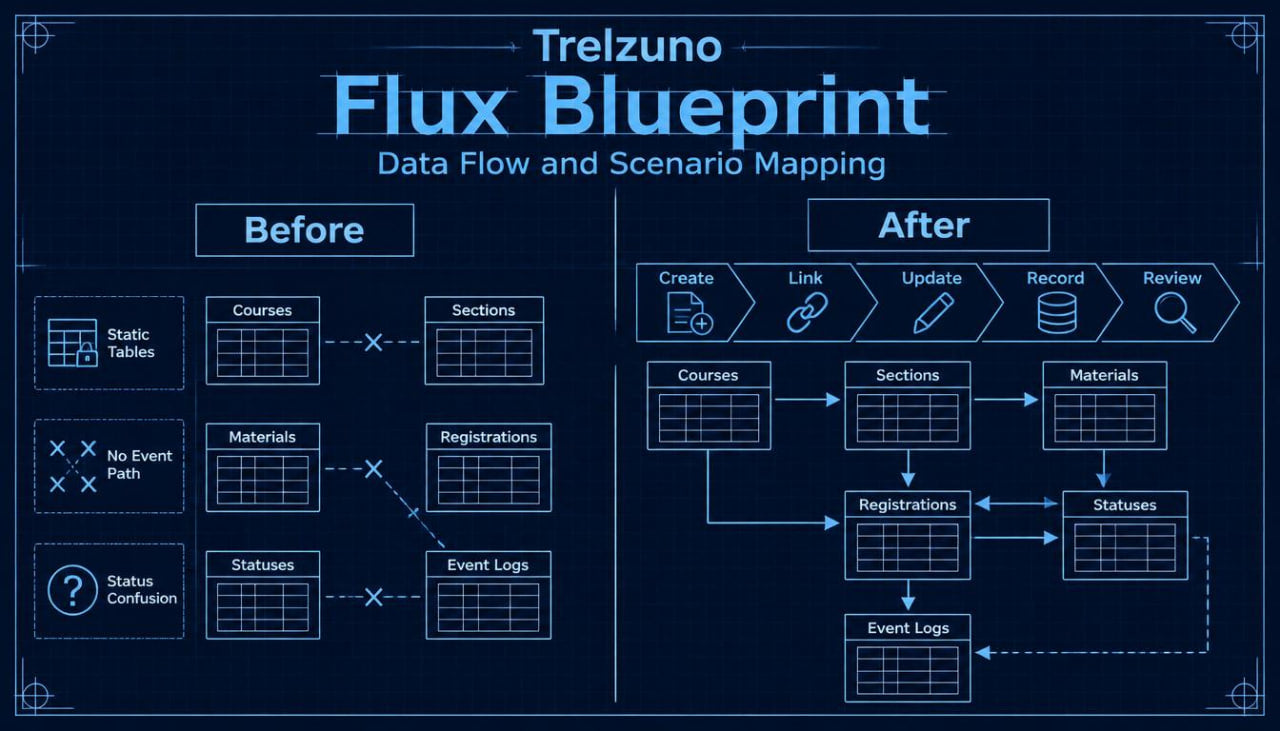
At the middle stage of learning, a learner often understands separate parts of a database but may not yet see how they behave in motion. Tables may be described correctly, and queries may work with separate data, but one question remains: what happens when records are added, updated, given a new status, or moved between stages. Without understanding these flows, a structure may look static, while data logic is often connected with actions and states. A learner may have a schema but still not know how to check whether it fits a learning scenario with several steps. That is why it is important to design a database not only as a set of tables, but as a system where information moves.
2. Solution
Flux Blueprint explains how to create a learning database through scenarios, stages, states, and links between actions. The plan helps learners describe the path of a record: from creation to update, from an initial status to the next stage, from a single table to a connected structure. The materials are built around examples where a database not only stores information but also shows how it changes over time. Learners study schemas with courses, sections, learning materials, learner registrations, statuses, and change logs. This approach helps prepare the structure for deeper queries, analytical selections, and learning projects.
3. What’s Inside
Flux Blueprint begins with a block about data flow. Learners review a database not as a frozen table, but as a system where records are created, changed, connected, and moved between states. The material explains why it matters to know not only where a value is stored, but also how it appears, when it changes, and which tables it interacts with.
The second block focuses on scenarios. Learners study how a regular process description can become a database structure. For example, a learner selects a course, a registration is created, the registration receives a status, the course has sections, sections have materials, and completed actions may be recorded in a separate table. The materials show how tables, fields, relationships, and log records are identified from such a description.
The third block explains record states. Learners meet the idea of status as a separate structure element. For example, a registration may be new, active, completed for a certain stage, or archived in a learning example. The material shows why statuses should be stored consistently and why they often belong in a separate reference table. This helps avoid chaotic text values in different parts of the schema.
The fourth block reviews movement between states. Learners see how one record can change its state depending on an event. For example, a request is created, then reviewed, then receives a new marker. The materials explain how to store the current state and when to add a separate table for change history. This block helps learners understand the difference between a current value and an event that has already happened.
The fifth block focuses on change logs. Learners study tables that record events: status change, material addition, section completion, description update, or relationship change between records. Each log has its own fields: event identifier, connected record, event type, date, note, and extra value. The material shows how these tables help read database history without mixing it with main tables.
The sixth block explains learning flows between tables. Learners review how one record may lead to the creation of another record. For example, creating a course may involve adding sections, sections may contain materials, and a learner registration may connect with a learning path. The materials show how these flows are described in a schema without extra duplication.
The seventh block focuses on event tables. Learners study when an event should be stored as a separate record. For example, when it is important to know when a section was marked as completed in a learning example, this can be described in a separate table. If only the current value matters, a field in the main table may be enough. The materials help learners distinguish between these two approaches.
The eighth block focuses on relationships within scenarios. Learners revisit one-to-many and many-to-many relationships, now through dynamic examples. One course may contain many sections, one learner may have several registrations, and one material may connect with several topics. The plan shows how such relationships affect future queries and reports.
The ninth block explains structure logic review. Learners receive a list of questions: what is created first, which records depend on one another, where the current state is stored, where events are stored, which tables are reference tables, which tables are main tables, and where duplication may appear. This review helps evaluate a schema carefully before it becomes more complex.
The tenth block contains a practical Trelzuno scenario. Learners work with a learning catalog database that includes courses, sections, materials, learners, registrations, statuses, and a change log. The task is to describe the flow: from course creation to adding sections, from learner registration to status change, from section completion to recording an event in a log. Each stage is divided into tables, fields, and relationships.
The eleventh block focuses on preparation for queries. Learners study how flow structure affects future selections. For example, it becomes possible to find records with a certain status, review change history, count materials in a section, or compare stages of a learning scenario. The material explains why a thoughtful structure makes queries easier to read.
The twelfth block contains the plan summary schema. It gathers the topics: data flow, scenarios, states, transitions, logs, event tables, dynamic relationships, logic review, and preparation for deeper queries. Learners see how a database can describe not only static information but also record movement over time.
4. Who Is This For?
Flux Blueprint is suitable for learners who have already studied basic ideas, schemas, field dictionaries, and first queries. It is useful for those who want to see a database as an active learning structure where records have states, events, and connections between stages.
This plan also suits learners who want to understand how to build a database for scenarios with several actions. When a learner can already create tables but does not always know how to describe a status change, event log, or movement between stages, Flux Blueprint helps organize these topics.
5. What You’ll Learn
- How to see a database as a system where information moves.
- How to turn a learning scenario into a table structure.
- How to describe the path of a record from creation to state change.
- How statuses work in a learning schema.
- How to store the current state of a record.
- How to separate a current value from a historical event.
- How to create log tables for changes.
- How to describe events through separate records.
- How to connect courses, sections, materials, learners, and registrations.
- How to analyze dependencies between tables.
- How to notice duplication in scenario-based structures.
- How to review movement logic between stages.
- How to prepare a schema for queries by statuses and events.
- How to read a structure where data changes over time.
- How to create a learning flow for the Trelzuno course catalog.
6. 30-Day Return Terms
For Flux Blueprint, there is a 30-day period for submitting a payment return request according to the Trelzuno store policy. Details about timing, review conditions, and request steps are described in the store policy so learners can read the procedure before placing an order.
Self-paced learning overview
- 🗂️ Digital file available after purchase
- 🕒 Long-term availability
- 🔐 Secure checkout
- 🗓️ Content updated in 2026
Are Trelzuno courses suitable for beginners?
Are Trelzuno courses suitable for beginners?
Yes, the materials are arranged so learners can move from basic ideas to more advanced topics gradually. Each plan has its own depth, so learners can choose a format that matches their current level.
How are the learning materials presented?
How are the learning materials presented?
The materials are presented through modules, explanations, examples, tasks, diagrams, and practical learning blocks. Everything is arranged so learners can work through the topics at a steady pace.
How do the plans differ from each other?
How do the plans differ from each other?
Each next plan includes a wider set of topics, more practical examples, and deeper explanations of database work. The first plans are suitable for orientation, while later ones explore structure, logic, queries, and project-based thinking in more detail.
Share