Trelzuno
Cipher Capsule
Cipher Capsule
Couldn't load pickup availability
1. Problem Statement
When learners move from separate tables to connected structures, queries become noticeably more detailed. It is no longer enough to select a few fields or filter records by one value. Learners need to understand how data from several tables comes together, how conditions affect the result, and why one small inaccuracy can change the entire selection. Learners may also become confused in tasks that require categories, statuses, dates, counts of related records, and log events at the same time. That is why this stage focuses on decoding complex queries as a sequence of clear steps.
2. Solution
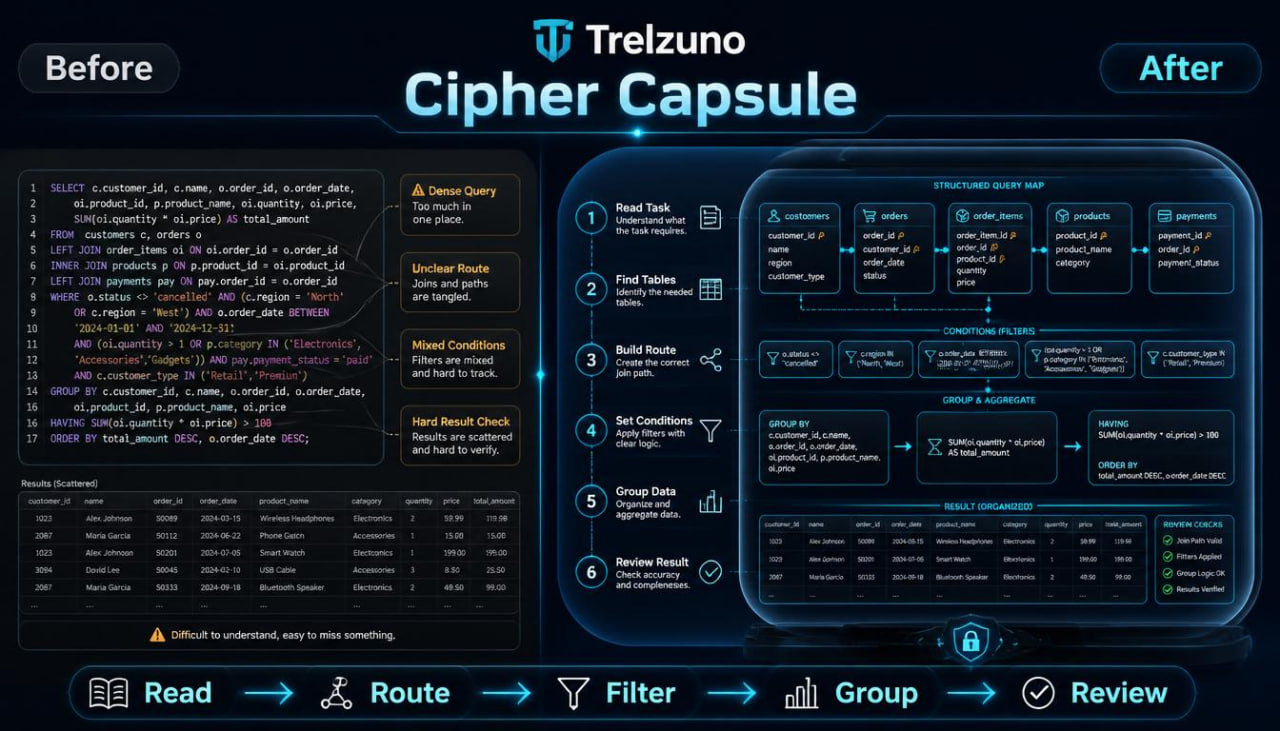
Cipher Capsule is built as a learning set for careful work with more detailed queries. The plan explains how to read a task, find the needed tables, define the route between them, form conditions, and review the result. The materials show how one learning selection can include several parts: a main table, connected reference tables, junction relationships, aggregated values, and additional conditions. In each block, learners move from a simpler example to a more detailed scenario. This format helps learners see not only the completed query, but also the logic behind each part of it.
3. What’s Inside
Cipher Capsule begins with a block about reading a detailed task. Learners study how to divide a written task into separate parts: which data should be shown, which tables provide it, which conditions should be included, how the result should be ordered, and whether counts are needed. For example, a task may ask to show courses from a certain category, the number of sections in each course, the number of materials in those sections, and the current status of a learner registration. The material explains why it is better to build a route before writing the query.
The second block focuses on routes between tables. Learners review the logic of moving from one table to another through keys and references. Examples include moving from course to sections, from section to materials, from learner to registrations, from registration to status, from material to tags, and from event to connected object. Each route is presented as a small schema so learners can see which tables are needed to answer a specific question.
The third block explains combining data from several tables. Learners study how a selection can show fields from different parts of the schema: course title, category title, section title, number of materials, and date of the latest event. The material shows how to read a result where each column comes from its own table. A separate part reviews cases where different tables contain similar field names, so the origin of each field must be read carefully.
The fourth block focuses on conditions in multi-table queries. Learners see how a condition may refer not to the main table, but to a connected one. For example, the task may ask to show courses that belong to a certain category, contain materials of a certain type, or include registrations with a specific status. The materials explain why it matters to know which table stores the field used for the condition.
The fifth block introduces nested queries in a learning format. Learners meet the idea that one query can support another: first find the needed records, then use them for a wider selection. For example, learners can first find courses that have sections with a certain number of materials, then show details for those courses. The material presents these examples gradually, without unnecessary terminology overload.
The sixth block focuses on aggregation. Learners work more deeply with counting records, grouping by categories, summarizing by statuses, and comparing the number of connected elements. For example, they may count materials in each section, registrations for each course, or log events for a certain action type. A separate part explains how grouping changes the result view.
The seventh block is about conditions after grouping. Learners study tasks where records should not only be counted, but only the groups that match a certain rule should be shown. For example, show only courses where the number of sections is above a chosen value, or only categories where several learning materials exist. The materials explain the difference between a condition for a single record and a condition for a group.
The eighth block reviews dates and time markers. Learners study how to select records by period, find the latest event, compare creation dates, and read log records in the right order. For example, they can find materials added after a certain date or registrations where the latest status change happened within a chosen period. The material explains why date format should remain consistent.
The ninth block focuses on missing and optional values. Learners review situations where a record does not yet have connected materials, where a status is not filled in, or where an event log is empty. The materials show how these cases affect selection results. This helps learners avoid confusing “no record exists” with “a record exists, but the value is empty.”
The tenth block explains result review. Learners receive a method for reading a detailed selection: first check the main table, then relationships, then conditions, then grouping, then ordering, and finally the total number of rows. Examples show how to find the place where a result became incorrect: an extra relationship, a condition from the wrong table, double counting, or a missing group.
The eleventh block contains the Trelzuno practical capsule. Learners work with a learning database that includes courses, categories, sections, materials, learners, registrations, statuses, tags, and an event log. Tasks include multi-table selections, counting materials, finding courses by connected statuses, analyzing events, grouping by categories, and reviewing results with a checklist.
The twelfth block is the summary query-decoding map. It gathers the whole plan into one sequence: read the task, find tables, build the route, define conditions, add grouping, review dates, include empty values, read the result, and explain the selection logic. With this, learners see a complex query not as one dense text, but as a set of understandable decisions.
4. Who Is This For?
Cipher Capsule is suitable for learners who already know layered schemas, keys, relationships, reference tables, and basic selections. It is useful for those who want to work more carefully with queries that draw data from several tables at the same time.
This plan also suits learners who understand separate query parts but lose orientation when grouping, nested conditions, log records, or several table routes appear in a task. Cipher Capsule helps organize this thinking and read more detailed tasks through sequenced learning steps.
5. What You’ll Learn
- How to divide a detailed task into parts.
- How to define which tables are needed for a selection.
- How to build a route between connected tables.
- How to combine fields from several schema parts.
- How to read the result of a multi-table selection.
- How to set conditions for connected tables.
- How to work with nested learning queries.
- How to count connected records.
- How to group data by categories, statuses, or types.
- How to filter groups by separate rules.
- How to work with dates and events in logs.
- How to understand missing or empty values.
- How to notice double counting in results.
- How to review a detailed selection with a checklist.
- How to explain query logic in plain language.
6. 30-Day Return Terms
For Cipher Capsule, there is a 30-day period for submitting a payment return request according to the Trelzuno store policy. Details about timing, review conditions, and request steps are described in the store policy so learners can read the procedure before placing an order.
Self-paced learning overview
- 🗂️ Digital file available after purchase
- 🕒 Long-term availability
- 🔐 Secure checkout
- 🗓️ Content updated in 2026
Are Trelzuno courses suitable for beginners?
Are Trelzuno courses suitable for beginners?
Yes, the materials are arranged so learners can move from basic ideas to more advanced topics gradually. Each plan has its own depth, so learners can choose a format that matches their current level.
How are the learning materials presented?
How are the learning materials presented?
The materials are presented through modules, explanations, examples, tasks, diagrams, and practical learning blocks. Everything is arranged so learners can work through the topics at a steady pace.
How do the plans differ from each other?
How do the plans differ from each other?
Each next plan includes a wider set of topics, more practical examples, and deeper explanations of database work. The first plans are suitable for orientation, while later ones explore structure, logic, queries, and project-based thinking in more detail.
Share