Trelzuno
Anchor Capsule
Anchor Capsule
Couldn't load pickup availability
1. Problem Statement
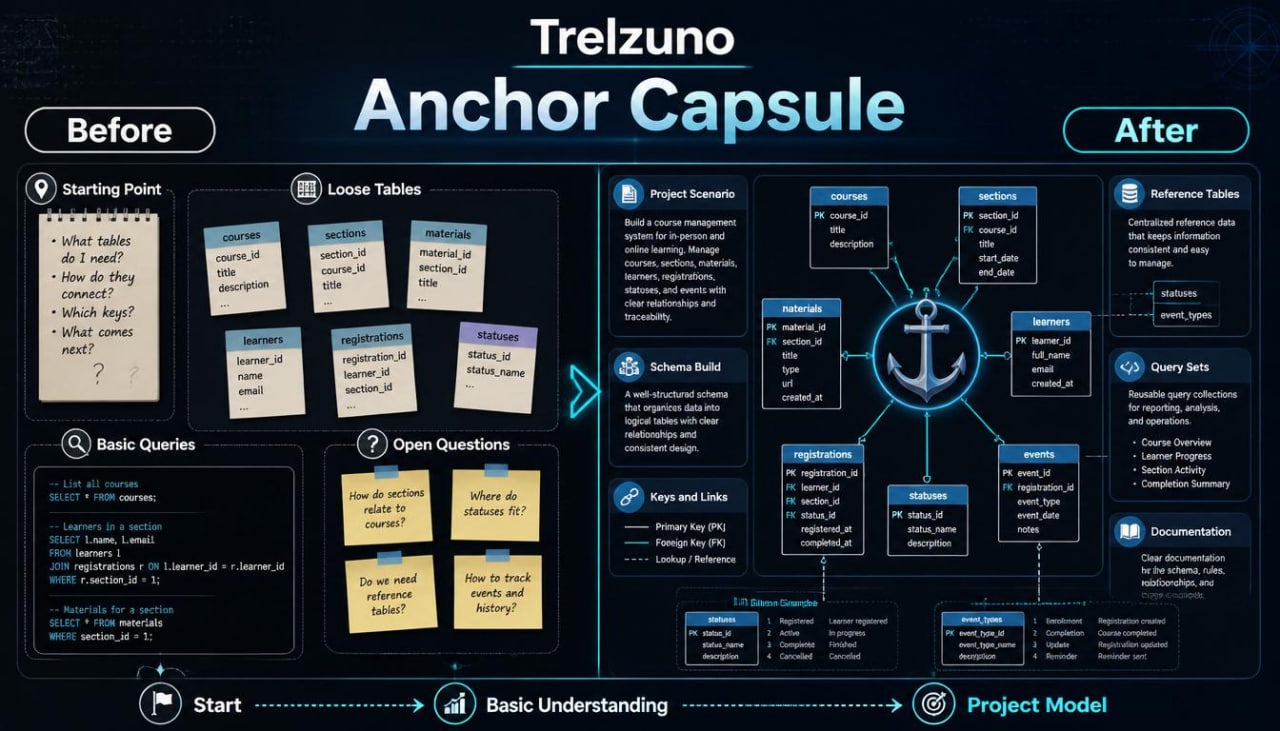
At the closing stage, learners already know tables, keys, relationships, layers, logs, multi-table selections, and control checks. However, the main difficulty often is not one separate topic, but the ability to bring all knowledge into one complete learning project. A learner may understand separate queries well, yet lose orientation while building a full structure from the first task description to final documentation. There is also a need to check whether tables are consistent, whether extra duplication is absent, whether relationships work correctly, and whether the logic of the whole model can be explained. That is why the final plan ties previous topics together through a full practical scenario.
2. Solution
Anchor Capsule is built as a closing learning project where the learner follows the full route of creating a database in a learning format. The plan helps begin with a subject-area description, identify objects, create a schema, describe tables, add keys, relationships, reference tables, logs, and control selections. The materials do not present topics as separate fragments only; they show how those topics work together inside one project. Learners practice explaining decisions, checking structure, finding weak points, and documenting the model so it can be read again later. This format fits the final stage of learning with Trelzuno.
3. What’s Inside
Anchor Capsule begins with a block about the full database work cycle. Learners review the sequence: task description, object identification, table creation, field selection, key definition, relationship planning, reference table creation, log addition, query writing, result review, and documentation. The material shows that a database does not begin with a table; it begins with careful understanding of which data should be stored and which questions should be answered.
The second block focuses on describing the subject area. Learners work with a Trelzuno learning scenario: there are courses, sections, materials, learners, course registrations, statuses, categories, tags, events, and summary selections. The task is not to rush into a schema, but first to describe which objects exist, which actions happen between them, which values repeat, and which values should be placed in separate reference tables.
The third block explains building the first schema. Learners create the first structure version: tables for courses, sections, materials, learners, registrations, statuses, categories, and events. The materials show that the first schema does not need to be the final one right away; it should be analyzed, refined, and cleaned. Learners practice asking questions about each table: what it stores, what role it has, what it connects with, and whether it contains extra data.
The fourth block focuses on refining fields. For each table, learners create a list of columns, describe the value type, field purpose, and data example. For example, a course table may have a title, short description, category through a reference, creation date, and status. A section table may include a course reference, section title, and placement order. A material table may include a section reference, material type, title, and short note.
The fifth block reviews keys and relationships. Learners define primary keys for main tables and foreign keys for connected structures. The materials explain how a course connects with sections, a section connects with materials, a learner connects with registrations, a registration connects with status, and an event connects with the object it belongs to. Special attention is given to making relationships readable and avoiding extra repetition.
The sixth block focuses on reference tables. Learners create separate structures for categories, statuses, material types, and tags. The material shows how reference tables help keep repeated values in one place. For example, instead of writing a status title many times in different tables, the structure can store a reference to the matching record in the reference table.
The seventh block reviews logs and events. Learners create tables for storing changes: status change, material addition, description update, and section completion marker in a learning example. The materials explain when storing the current value is enough and when event history should be added. This helps separate main records from time-based changes.
The eighth block focuses on query sets. Learners prepare several groups of learning selections: basic selections from one table, selections from several tables, counts, grouping, searching records by status, event checks, and summary views. For example, learners may show all courses with categories, count sections in each course, find registrations with a certain status, or review recent events for a chosen object.
The ninth block explains structure quality review. Learners check for duplication, empty important values, incorrect references, records without matching reference rows, events without objects, or tables without a defined role. The materials include a checklist that helps go through the schema step by step and find places that need refinement.
The tenth block focuses on documentation. Learners create a description for the whole model: a short database idea, table list, role of each table, main fields, relationships, common queries, control checks, and structure notes. This description helps the model remain readable not only during creation but also during later review.
The eleventh block contains the final Trelzuno learning project. Learners receive a full scenario and follow all stages: task analysis, schema building, table refinement, reference table creation, relationship description, query preparation, data quality review, and documentation writing. By the end, learners have a complete database learning model that can be explained from beginning to end.
The twelfth block is the summary map of the whole Trelzuno route. It shows how previous plans connect with one another: from table orientation to a full model, from simple queries to summary selections, from separate relationships to complete documentation. Anchor Capsule closes this line as the plan where all parts come together in one learning project.
4. Who Is This For?
Anchor Capsule is suitable for learners who have already studied basic and middle-stage topics and are ready to work with a full database learning structure. It is useful for those who want not only to read separate schemas or queries, but also to build a model from task description to final documentation.
This plan also suits learners who want to review all key Trelzuno topics in a systematic way: tables, fields, keys, relationships, references, logs, queries, grouping, control checks, and structure description. Anchor Capsule is created as the closing point of the learning line.
5. What You’ll Learn
- How to follow the full cycle of creating a database learning model.
- How to analyze a task description before building a schema.
- How to identify main objects in a subject area.
- How to create an initial table structure.
- How to refine fields, value types, and column purposes.
- How to define primary and foreign keys.
- How to build relationships between courses, sections, materials, and learners.
- How to create reference tables for statuses, categories, types, and tags.
- How to separate events from main records.
- How to prepare learning selections from one or several tables.
- How to create counts and grouping.
- How to review structure for duplication and inconsistency.
- How to find records without needed relationships.
- How to prepare documentation for a database.
- How to bring all previous topics into one learning project.
6. 30-Day Return Terms
For Anchor Capsule, there is a 30-day period for submitting a payment return request according to the Trelzuno store policy. Details about timing, review conditions, and request steps are described in the store policy so learners can read the procedure before placing an order.
Self-paced learning overview
- 🗂️ Digital file available after purchase
- 🕒 Long-term availability
- 🔐 Secure checkout
- 🗓️ Content updated in 2026
Are Trelzuno courses suitable for beginners?
Are Trelzuno courses suitable for beginners?
Yes, the materials are arranged so learners can move from basic ideas to more advanced topics gradually. Each plan has its own depth, so learners can choose a format that matches their current level.
How are the learning materials presented?
How are the learning materials presented?
The materials are presented through modules, explanations, examples, tasks, diagrams, and practical learning blocks. Everything is arranged so learners can work through the topics at a steady pace.
How do the plans differ from each other?
How do the plans differ from each other?
Each next plan includes a wider set of topics, more practical examples, and deeper explanations of database work. The first plans are suitable for orientation, while later ones explore structure, logic, queries, and project-based thinking in more detail.
Share